
Not Your Guru: The Radical Ethics of Refusing to Heal Someone
Article 3 of 12 | Facilitating Transformation: Insights from the Psychedelic Underground
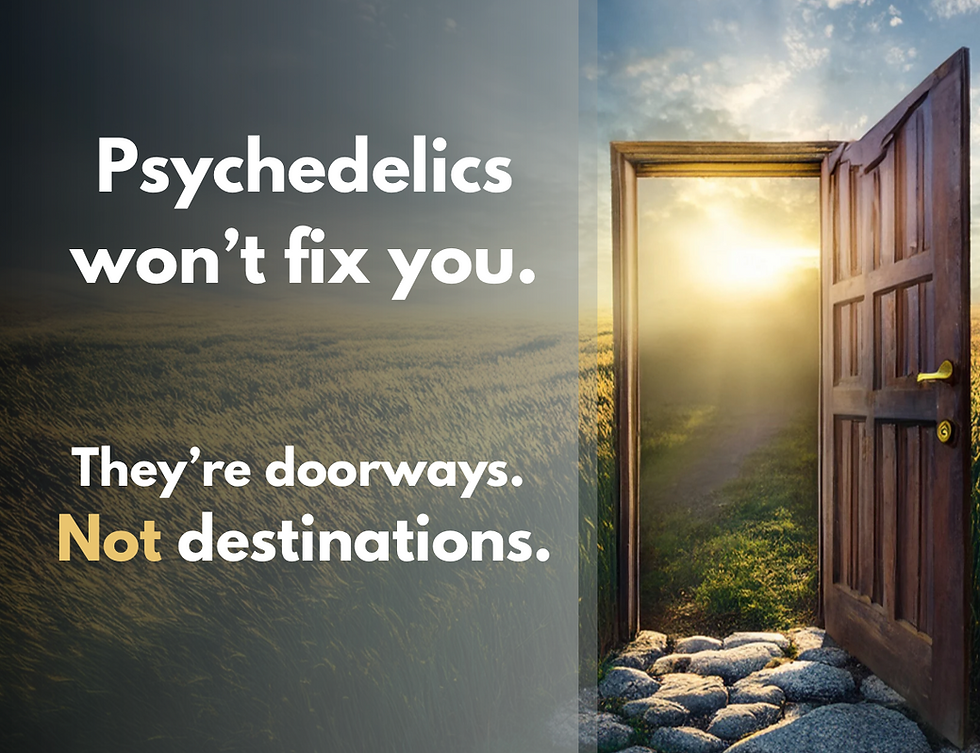
If you sat down to work with one of the facilitators I interviewed, you'd probably hear something unexpected from them: they do not want to heal you.
But this isn't because they don’t want you to heal, but because they will insist that the healing is yours. And that their job is not to lead you, but to help you find your own leadership on your healing path.
For me, this is one of the most striking and consistent findings from my dissertation research: the facilitators I interviewed - nearly without exception - rejected the role of guru, healer, or spiritual authority. And they took this rejection seriously as a philosophical position and ethical imperative.
Understanding why they won't be your guru, and what they offer instead is something that I believe is essential about what psychedelic facilitation at its best is trying to do.
The problem with the guru role
In altered states, the psyche becomes highly impressionable. The boundaries between self and other can blur. For this reason, authority figures can hold disproportionate influence. A facilitator who positions themselves as a healer, expert, or guide can shape the entire arc of someone’s experience, and not always in the direction that might be best for the journeyer in the long run.
Facilitators in my research named this as one of the most important reasons to be intentional about how they hold their role. Many described encountering seekers who arrived hoping to hand their healing over to someone else:
“Some people still want somebody to be in charge of them. They’re still looking for the guru, they’re still looking for something outside of themselves. So my medicine can be a challenge to hold because it requires complete responsibility for the self" (Interviewee 2).
The antidote, many agreed, was more than just refraining from claiming authority. It was to actively dismantle it. I really appreciated this quote where a facilitator described restructuring even small ceremonial moments to redistribute power:
“An intention I have in a ceremony is to break down hierarchies. I’m always asking that in every little piece of the ceremony that we do. I used to bless the medicine on a crystal. I don’t do that anymore. It’s like, I bless it, and then I hand it to them and I say, you bless it… I’m just always asking, how can I tear these levels down, right? I tell people there’s nothing I’m doing that they can’t do. It just might take them time to learn it” (Interviewee 25).
The hollow bone
So if facilitators aren't someone's guru, what are they instead? The metaphor that emerged most powerfully across interviews wasn’t that of a healer or a guide, but a hollow bone.
“I just seek to be a hollow bone and to not make it about me” (Interviewee 19).
In Indigenous healing traditions, a hollow bone is a spiritual intermediary who has cleared themselves of ego, personal agenda, and attachment so that healing energy might move through them freely. The facilitator is not the source. They are the channel.
This framing has practical consequences. Facilitators described making deliberate efforts to avoid projecting their own beliefs, frameworks, or interpretations onto a journeyer’s experience. Several replaced credit when someone attributed their healing to the facilitator’s presence:
“Our place is to honor and trust the process and surrender in the humility that we don’t get it. You’re never becoming their person, their guru, their expert. When they say you did this for me, you know, always turn that back around: I was just with you, and you did it. Spirit did it, you know? Stay in reverence for what can be done if we step out of the way...there’s the mystery and magic” (Interviewee 3).
Another facilitator put it simply: “I am reluctant to give myself any kind of formal title. I think we’re in an age where people are their own guru. They just need to have the support and space to hear what rings true for them” (Interviewee 19).
The spotter, the companion, the mountain guide
Facilitators offered a rich range of metaphors for how they view themselves.
One preferred the word “spotter” over “guide”:
“A guide walks in front of someone and says, ‘Follow me. Do what I do.’ A spotter stands on the ground, holds your safety rope while you’re climbing a mountain. And if you get stuck, the spotter says, hey, there’s a handhold, like up and to your left, reach up there" (Interviewee 13).
Another described it as walking alongside someone on a mountain you know well, but not walking it for them:
“It’s like we’re on the mountain and there’s a trail. I know this mountain like the back of my hand. I’ve been on it, but I don’t know what it’s like for that person to walk on the mountain. They have to do the trek, but I can be right there with them the whole time" (Interviewee 1).
Others described it in terms of presence without direction, a ministry of accompaniment rather than authority. As one facilitator with chaplaincy training explained: “The work is to be present with suffering and companion it. I don’t assess and treat and diagnose, and I don’t have a therapist mindset.”
What all of these metaphors share is a fundamental repositioning of expertise. The facilitator knows the terrain. The journeyer knows their own experience. Neither can substitute for the other.
Teaching people to trust themselves
Another emphasis facilitators shared was on fostering what many called “inner authority” or "inner healer" which emphasizes a journeyer’s capacity to trust their own experience, wisdom, and healing intelligence.
“It’s important that people learn how to listen to and trust themselves. That’s something we’re not taught, right? We’re taught that somebody else has the answer. I think that’s a big part of this path, accessing your own inner healer and your own wisdom, learning how to listen to that, because that’s what will guide you” (Interviewee 12).
One facilitator named the contrast with more hierarchical models directly:
“I think teaching someone to trust themselves and not me is unique. I don’t know all the rules. I don’t know all the things. Staying with that not knowing, that learning mindset, and remaining curious is key. It’s a different way of doing medicine compared to some of the experiences that I’ve had where the shaman knows and they’re in charge, and they tell you how much medicine, they tell you what you’re supposed to do… there are so many rules, which for me, creates that child to parent relationship — so I’m trying to help people grow up” (Interviewee 2).
This reflects a developmental understanding of what healing actually is. To “help people grow up” is to support the emergence of self-authorship and the capacity to trust one’s own knowing rather than perpetually deferring to an external authority.
The deeper wound and why this matters beyond psychedelics
The philosophical stance these facilitators have adopted isn’t unique to psychedelic healing.
It echoes centuries of thought across contemplative and spiritual traditions. One facilitator named the lineage directly:
“If we can orient people to the wisdom that’s within them, the infinite life that’s within them, I believe that was the original intent of Jesus Christ. I believe that was the original intent of Muhammad and Buddha and the incredible female mystics - helping people reorient back to their own power and connection to the Infinite One” (Interviewee 18).
And one facilitator gave language to the wound this work is ultimately trying to address:
“There needs to be a space that is safe for an individual’s gorgeous consciousness to learn that they can have things their way… They can trust themselves. And that to me, is the original wound. The turning from the self, the belief that someone else outside of me knows better for myself. So the ultimate healing is to come back to that wound and to know that there is no one above me, that I am the master of my life” (Interviewee 2).
This is what it means to not be someone’s guru. It’s a massive disclaimer and radical act of trust.
My hope is that perhaps the invitation extends to all of us, and not just in medicine spaces either. I hope we can learn to better listen to ourselves, to trust our inner-wisdom, to nourish our inner-healer, and become the guide we have been looking for.
I am so grateful to the facilitators who continue to step out of the way so they may help others find theirs.
—
This article series is based on original dissertation research interviewing 27 underground psychedelic facilitators across the United States.


Comments