
No Magic Pill: What Psychedelics Actually Do (According to Underground Facilitators)
Article 4 of 12 in the series “Facilitating Transformation: Insights from the Psychedelic Underground”
Conversations about psychedelics are brimming with myth and misinformation. And it makes sense given our tumultuous history with them: prohibition, the War on Drugs, the this-is-your-brain-on-drugs commercials on repeat. So if your relationship with psychedelics is confusing or complicated - especially considering the federal government's latest push to fast-track psychedelic research and eventual access - there's good reason.
For my doctoral research, I interviewed underground psychedelic facilitators across the United States. These were individuals who have spent years, sometimes decades, working directly with these substances. They know them more intimately than almost anyone in our culture and I believe their perspectives are worth sitting with. What they shared challenges some of the dominant narratives we’re hearing today.
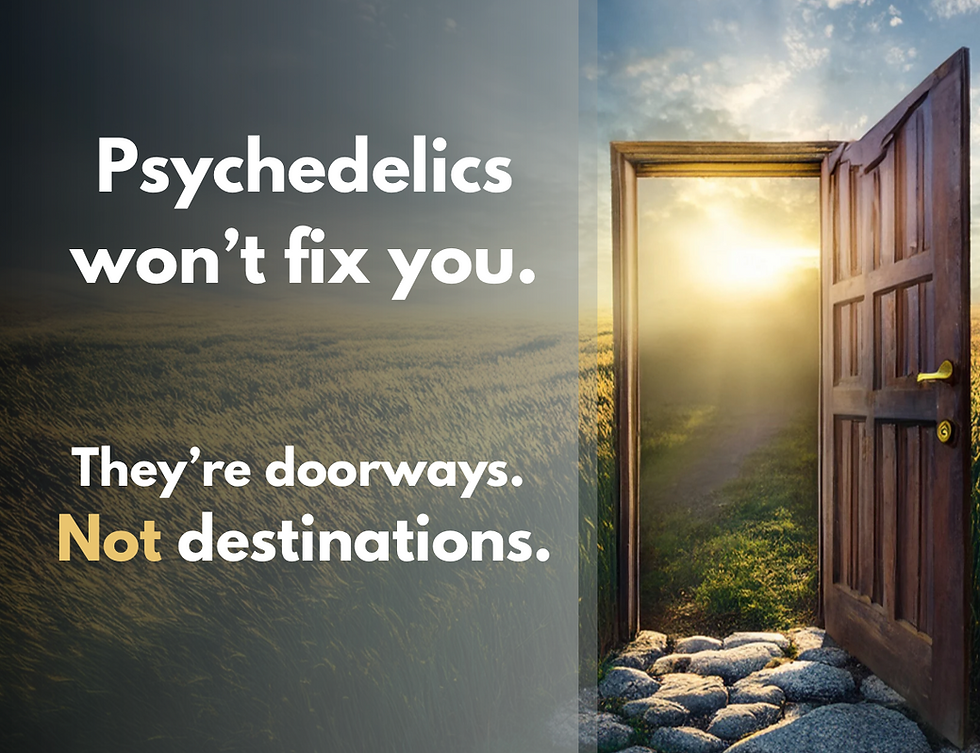
Facilitators didn't all agree on what psychedelics are. Some framed them through science, others through spirituality, many through both. But beneath the different frameworks, a remarkably consistent picture emerged: these substances are powerful, yes. But they are tools, not cures. Doorways, not destinations. And how you meet them matters enormously.
Here's what they shared, across four themes.
The Science: Neuroplasticity and Pattern Disruption
Several facilitators described the neurobiological dimension of psychedelic healing. Specifically, the capacity of these substances to enhance neuroplasticity, the brain’s ability to form new neural pathways. This is actually a very well-supported mechanisms in current psychedelic research.
One facilitator explained how they frame this for clients:
“I tell people: this creates neuroplasticity which allows your brain to be more open and receptive to new ways of thinking. At the end of the day, it creates neuroplasticity, period. So people are experiencing reregulation of the central nervous system, and they’re also experiencing a wonderful neuroplasticity. They lose the resistance. We soften the resistance to the change, and we soften the resistance to our own inner wisdom” (Interviewee 14).
Another described the implications for how people interpret their own stories:
“What psychedelics are really helpful for is the neuroplasticity that allows for us to see things differently. The way that we’ve seen things — over and over again — the way that we understand things has been so ingrained in us in society. What we’re doing is we’re trying to help people see that there’s other ways of seeing that same story. And that healing can be hard, and it also can be joyful, and it also can be whatever we want it to be. But you can do that from a space of conscious creation instead of encumbered by these deep stories” (Interviewee 4).
The window of neuroplasticity that psychedelics open is real, but it’s just that: a window. Because windows don’t stay open forever, what enters or is cultivated during that time matters.
With conscious care and intention, neuroplasticity can support the formation of new patterns and beliefs. Without it, it can just as easily reinforce the very patterns we’re hoping to change.
Tools, Not Cures
Unanimously, the facilitators in this study rejected the idea that psychedelics are panaceas. They shared how these substances are not the medicine, but they can help you access your own.
“These substances are important allies. But ultimately, they’re not the medicine. Ultimately, they are just helping you access your own. They just help open the door for you to connect with your own medicine. But none of them can heal you like you can only heal yourself” (Interviewee 12).
One facilitator offered a broader perspective on what this means for healing modalities in general:
“Medicine itself is a tool. It helps us get to where we want to go because my goal is to help that person connect with their higher self and get rid of our ego… I feel like medicine can get you there. Hypnosis can get you there. Breathwork can get you there. Yoga, meditation, all those things can get you past that ego. So whatever can get you through that door, yeah, that’s what I want to do” (Interviewee 5).
Agents of Disruption (Which is somewhat the Point)
So what do psychedelics actually do that other healing modalities or tools don’t? The facilitators in my research were clear on this: they accelerate and deepen the work through destabilization.
“I think psychedelics accelerate therapy because it just allows people to go so much deeper. We need the mind to kind of step away for a bit… Let’s really get into the subconscious, where inhibitions are down and we’re less likely to get in our own way in that place” (Interviewee 8).
But destabilization comes with a cost. The same facilitator was candid about this:
“In just talk therapy, there’s not too much destabilization that’s happening, but we’re also sort of only insight oriented there. With psychedelics, there’s a higher price to pay — the destabilization — if you want to accelerate the healing process. People are way more destabilized doing this work, but they get better faster and they get better” (Interviewee 8).
It's worth noting here that disruption alone is not inherently healing. Without intentional support and reorganization, it can just as easily lead to fragmentation or instability. And facilitators described tending to this disruption as an essential feature of the process:
“It’s not a magic pill. This isn’t a one-hit wonder. It’s work. And things can get worse before they get better. Like everything’s amazing, everything’s wonderful. Then everything’s gonna come down. Why? Because that’s how you level up. It’s called the healing crisis” (Interviewee 22).
Spirit Allies
For many of the facilitators I interviewed, psychedelics are not merely mind-altering substances — they are sentient, sacred presences. This perspective aligns with Indigenous communities that have developed relationships with these plants for thousands of years. It offers a fundamentally different way of understanding these experiences than the clinical model, yet often arrives at strikingly similar conclusions about how to work with them.
“I introduce people to medicine from a spiritual worldview, from a shamanic view… the relationship here is with medicine. And so with every one of my people, I have introduced the medicine as a spirit ally. If you’re inviting (the medicine) into your body, know that she is for you and she is a healer, and she is here to be with you and support whatever the wisdom of your heart, soul, body knows needs done. She is there to ally with it” (Interviewee 3).” (Interviewee 3).
“Plant medicine is a teacher. It’s a guide, it’s a swami, it’s a guru. It doesn’t take your pain away. At the end of the day, you’re the one that has to put everything in the trash bin or recycle it… but you still have to do the work. No one’s gonna do it for you, and certainly not the medicine” (Interviewee 22)
From this more spiritual orientation, a spirit ally may offer insight, perspective, or direction, but it does not do the work on your behalf. The responsibility remains with each individual to integrate the insight that emerges.
What This Means for You
Whether someone understands psychedelics through a neuroscience lens or a spiritual one or some combination of both, the facilitators in my study pointed to the same essential truth: these medicines can open doors, but you still have to walk through them.
The medicine doesn’t heal you.
It reveals. It opens. It disrupts.
But the healing? That’s all yours.
Next up: one of the least discussed but most crucial aspects of psychedelic work: the screening process that happens before anyone takes anything at all.
This article series is based on original dissertation research interviewing 27 underground psychedelic facilitators across the United States.


Comments